HOLOCAUST:
A Mutant Blood-Lust
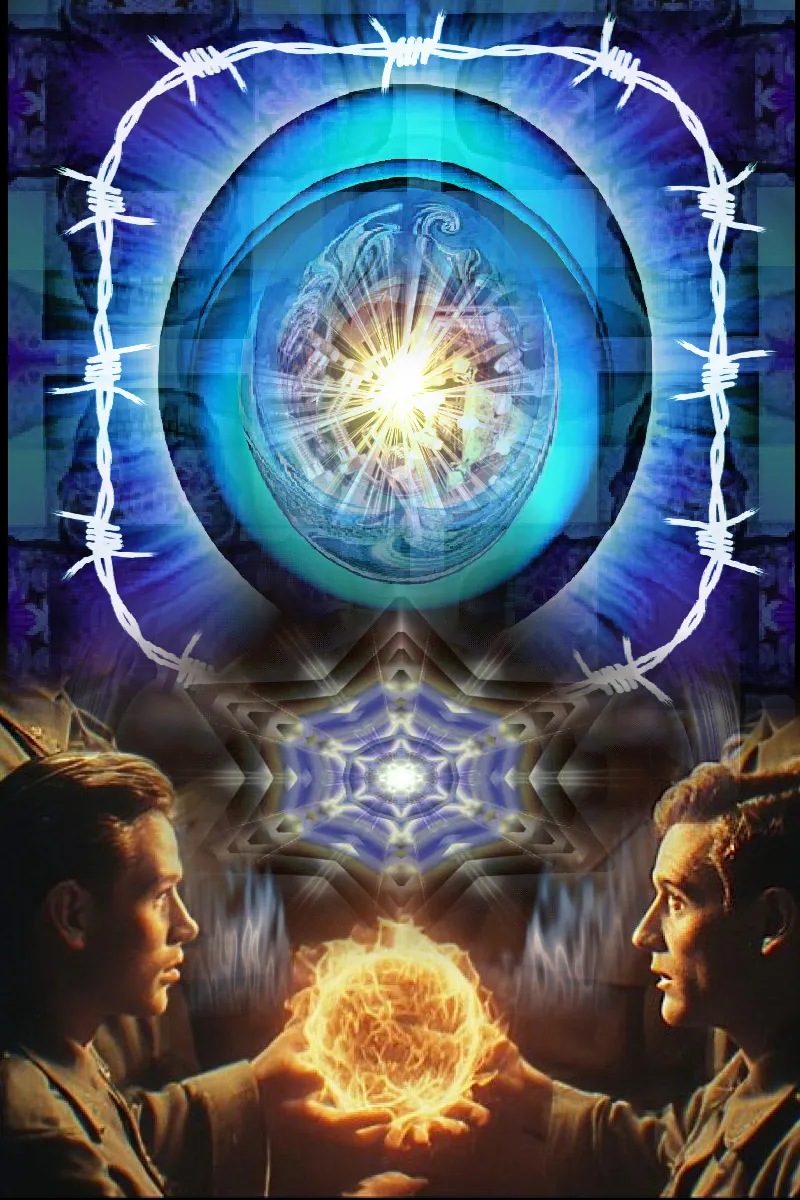
boots beat hard at harsh command;
stomping grim-faced in rigid lines,
drunk on dreams of imperial designs.
Slogans about end-times start to knell,
as soldiers sing “Amerika 1st!” swell;
as dissenters fall covered in flames,
and wild fury floods through the world.
Oil-black rivers blaze with dread,
embers echoing countless dead;
nuclear night—cold, crystal-bright—
needle through stars with searing light.
Is there some ancient or ashen ache,
of a buried beast we dare not speak?
A rusted rage, a blood-bound cry,
that begs for battle, bids us die
as Rambo-warriors numb their minds
and compu-screens make millions blind
and military-industrialists
count gold, ignoring sanctioned lies?
How swiftly slogans seize the soul,
how easy lies can lead, control;
young minds molded, muscled, mined—
and doubt dismissed, dissent declined.
then silence and exile the few refusing to align.
Brice stared at the digital projection of the poem and image, his brow furrowed in a mixture of confusion and growing irritation. "What the heck is this author even saying?" he muttered, ignoring the digital projection. He looked at his friends He leaned forward with a mix of irritation and unease. "Is there some mutant Zionist message buried in this, or am I just missing the point?" The question hung there—heavy, edged, dangerous.
Devani slowly shook her head, her expression softening with a quiet, certain sorrow. "I don't think so," reply, her voice steady despite the tension in the room. "The author abhorred all forms of systematic violence. It isn’t about one group; it’s about systems—about cycles. About how violence becomes normalized, mechanized… even ritualized." Her fingers tightened slightly as she spoke. "The author isn’t defending anyone. He’s condemning the machine itself.”
A sarcastic frown pulled at Brice’s features as he leaned back, crossing his arms defensively. "That’s idealistic," he snapped, his voice dripping with cynicism. "History isn't a poem, Devani. It’s essentially a protracted struggle of countless '-isms,' each one clawing and yearning for its own ascendancy." He crossed his arms tightly, as if bracing against something unseen. "History isn’t some neat moral fable," he continued, his voice gaining force. "It’s a battlefield of ideologies—nationalism, capitalism, extremism—each one clawing for dominance. People don’t just ‘get caught in systems.’ They choose sides. They fight. They win. And sometimes they lose."
Anya, who had been staring off into the distance, spoke up so softly she was nearly drowned out. "We are like tiny, seemingly insignificant grains of rice over a flame," she whispered.
Brice frowned. "What?"
Anya lifted her hands slowly, her fingers curving as if cradling something fragile and unseen. "Tiny grains," she repeated, a little louder now. "Scattered in a pan… over a flame." Her fingers trembled slightly as she traced a slow, circular motion. "At first, nothing happens. Then—heat builds. Pressure builds. And suddenly, some grains pop. Others begin to burn. All of us are in a hot charnel ground. However, many people try to ignore this." A perplexed silence followed her speech.
Carlos shifted in his chair, the faint scrape of wood against tile sounding unnaturally loud. He had been watching the projected image with an unreadable expression. "The fire is not necessary," he said quietly, "there must be a way to avoid its flames." Something in the way the friends were seen the image had shifted—subtly, irrevocably.